

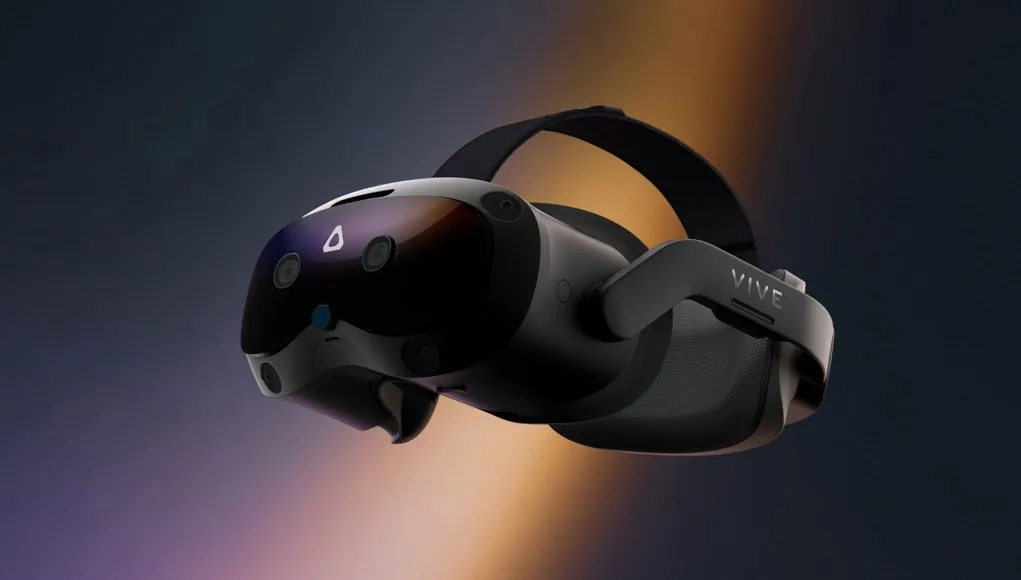
Updated on October 2, 2026: The HTC VIVE Focus Vision It was introduced in September 2024. It is therefore not a new headset of 2026, but HTC will continue to market it as a standalone and PC VR device. This post sorts out the hardware, its business features, and the question of whether it is still a suitable choice today.
The embedded product video comes from the device’s launch and can be understood as a manufacturer demo at the time. Since then, the market has evolved: PICO introduced the PICO 4 Ultra Enterprise as a business model, Samsung launched the Galaxy XR 2025, and Valve listed Steam Frame in its hardware lineup in 2026. The following information about the Focus Vision refers to HTC’s current German product information.
Technical specifications of the VIVE Focus Vision
HTC positions the Focus Vision as a standalone XR headset that can also be connected to a PC. Less important for categorizing purposes are marketing terms such as “connect to PC” or “connect to mobile device.” The most important manufacturer specifications are:
| Feature | Manufacturer's description / Classification |
|---|---|
| Displays | Two LCD panels, 2448 × 2448 pixels per eye (4896 × 2448 combined) |
| Refresh rate | 120 Hz in DisplayPort mode, currently indicated as beta support |
| Field of vision | Up to 120 degrees |
| Processor and memory | Qualcomm Snapdragon XR2, 12 GB RAM, 128 GB storage; microSD expansion up to 2 TB (card not included) |
| Tracking and Passthrough | Inside-out tracking, eye-tracking cameras, two color passthrough cameras, depth sensor, and infrared illumination |
| PC connection | Streaming via Wi-Fi or via DisplayPort. The appropriate cable and the streaming converter are required for DisplayPort; the VIVE Wired Streaming Kit is offered separately. |
For operation with multiple users, HTC mentions automatic IPD adjustment, magnetically attached and washable pads, and a balanced weight distribution. The official specification also includes space for glasses with a width of up to 150 millimeters and active cooling. These are helpful features for shared training equipment, but they do not guarantee a suitable fit for every person. Before roll-out, the team should test fit, comfort, training instructions, and cleaning with the intended user groups.
With PC streaming, the result does not depend solely on the headset. HTC explicitly points out the dependence on PC performance, software settings, and network connection. For wired DisplayPort streaming, the compatible kit and the beta limitation of 120Hz support are added. These points should be examined in the pilot project in conjunction with the final PC configuration.
An important difference: According to HTC, the DisplayPort connection provides a direct wired PC VR connection; 120 Hz is labeled as beta there. PC performance, application, settings, and connection all affect image quality and latency. The Focus Vision should therefore not be selected solely based on the maximum field of view or the number of pixels. For architecture, training, or simulation, it matters how the respective application performs on the specific configuration.
Standalone, PC VR and mixed reality in use
In standalone operation, compatible content runs on the headset itself. This makes setup easier and can be practical in training rooms, during demos, or for mobile installations. Eye-tracking supports, among other things, automatic adjustment of pupil distance; in addition, HTC lists Foveated Rendering and Eye-Movement analyses as possible features, provided that software and application support them.
For mixed reality, the Focus Vision uses color passthrough cameras and a depth sensor to combine digital objects with the real world. Again, the app is crucial: A camera or sensor does not guarantee that every application correctly implements spatial surfaces, occlusion, or hand interactions. Before a larger installation, tracking should be tested under actual lighting conditions, the setup of the game area, and with the target audience.
HTC also mentions a replaceable rear battery. According to the manufacturer, an integrated backup battery only keeps the device running briefly during the replacement process; it is not a replacement for a full battery. For frequent battery changes, this is nevertheless an advantage if replacement batteries, charging stations, and hygiene procedures are planned from the outset.
Technical specifications of the HTC VIVE Focus Vision
What HTC requires for commercial use
For companies, it is not enough to purchase a consumer device and use it in operation. HTC distinguishes between a Business Edition and devices that are subsequently activated for commercial use. According to the current VIVE Business page, a VIVE Business Warranty & Services Agreement (BWS) with registration and activation is required for commercial use. The Business Edition includes two years of BWS; with a regular edition, an upgrade is provided within 90 days. Activation, duration, and any associated fees should be clarified directly with HTC before purchase.
With VIVE Business+ enabled, features for device management are available depending on the plan. HTC also mentions support for third-party MDM solutions, including Microsoft Intune, AirWatch, and ArborXR. Certain advanced features require an upgrade. Therefore, do not just check whether „MDM support“ is offered, but also which specific feature is included in which package: registration, app distribution, remote configuration, monitoring, and updates can be managed separately.
The business features can make the Focus Vision interesting for professional or location-based applications. However, this decision is tied to HTC's terms of service, support model, and the additional hardware required. For repeated training sessions with many users, costs for BWS, replacement batteries, pads, charging infrastructure, and the DisplayPort components should also be factored into the overall cost.
VIVE Focus Vision or PICO 4 Ultra Enterprise?
For a PC-based application, an existing VIVE workflow, or an installation where DisplayPort mode is crucial, the Focus Vision may be useful. If a standalone, managed fleet of multiple devices is the focus, the PICO 4 Ultra Enterprise should be tested at least as effectively. PICO has its own Enterprise OS, Business Store, and Device Manager, and the German product page lists current prices and variants. For many typical standalone training projects, this is a straightforward starting point. The specific choice still depends on the software stack and operating conditions.
The current market includes additional device categories: Samsung Galaxy XR is based on Android XR and has been available in select markets since 2025. Valve has listed Steam Frame since 2026 in the Steam hardware category. Meta, in turn, announced its approximately 100-gram lightweight VR glasses for spring 2027 in September 2026. These models are not automatically direct replacements for the VIVE Focus Vision: platform, availability, input methods, and business management differ. For a broader, more up-to-date comparison, see our VR headset comparison 2026. Current background information about Meta VR Glasses and to Meta's B2B course change the respective product strategies are handled.
Conclusion: The HTC VIVE Focus Vision will remain a listed 2024 headset in 2026 with standalone, PC VR, and mixed reality capabilities. For business projects, the mandatory BWS requirements, PC and streaming add-ons, and the required MDM functionality are part of the purchasing decision. Those choosing today should test them against current business options such as the PICO 4 Ultra Enterprise and not be guided by the then-new product communication.
Sources from manufacturers: HTC VIVE Germany: technical data; HTC VIVE Business: Commercial use and management; PICO Germany: PICO 4 Ultra Enterprise.


