

VIRTUAL REALITY FOR MEDICAL TRAINING
Train clinical situations safely and repeatably
Those who want to use virtual reality for medical training can place learners and professionals in realistic situations without burdening real patients, treatment rooms, or ongoing hospital operations. Medical procedures, nursing interventions, conversation scenarios, technical terminology, and defined decision-making scenarios can be systematically practiced, repeated, and evaluated in a virtual environment. Design4real develops customized VR training solutions for hospitals, care facilities, universities, educational providers, and healthcare companies—tailored to specific learning objectives and everyday operational use.
Virtual Reality for Medical Training at a Glance
The decisive advantage does not lie in simply converting existing training materials into a VR headset to transfer. It makes sense Virtual Reality for medical training where spatial perception, workflows, communication, decision-making pressure, or repeatable practice play a role. A good application therefore combines medically verified content with clear training didactics and an operation that remains understandable even for users without VR experience.
In 2026, the World Health Organization emphasizes the growing importance of simulation-based and immersive learning methods for the qualification of healthcare professionals. The focus is not only on technical skills, but also on teamwork, communication, and leadership. At the same time, research shows that learning success depends heavily on the learning objective, scenario design, target group, and implementation. Therefore, VR is not an end in itself, but a tool within an overall didactic concept.

Where virtual reality is particularly useful for medical training
Train clinical workflows and care processes
Many medical and nursing tasks consist of clear sequences: preparing, checking, acting, documenting, and responding to changes. In a VR simulation, these steps can be depicted in a controlled scenario. Learners receive tasks, make decisions, and directly see the consequences that individual actions have within the training model.
This is particularly helpful when real training situations are available to a limited extent or cannot be repeated as often as desired. Even rare situations can be specifically integrated into the training plan. It is important to note that the application does not claim to replace a real clinical competency assessment. Rather, it can be used as a supplementary practice environment in which certain procedures or decision points can be prepared and reinforced.
A public Design4real example is the project „Imagine“. For the VR Training realistic situations from everyday nursing care were implemented. The goal was to familiarize nursing staff with typical situations and decisions in dealing with patients in a virtual environment.
Communication, patient consultations, and medical terminology
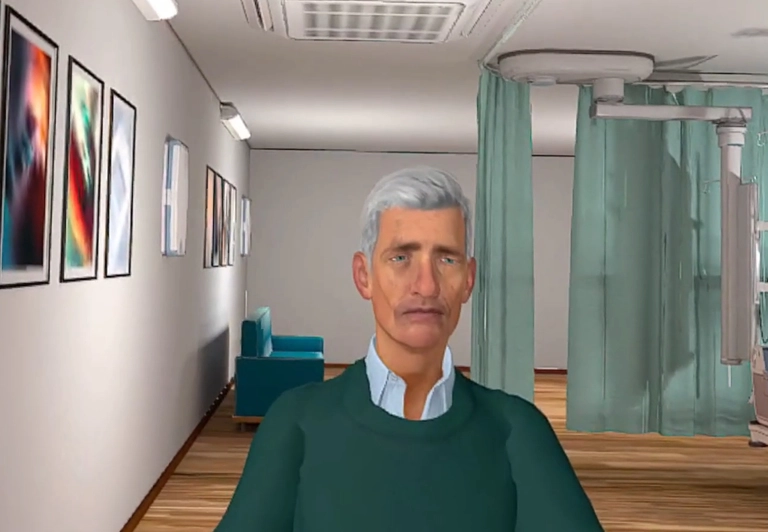
Virtual reality for medical training is not only suitable for technical procedures. Communication situations in particular can be trained in a structured manner within a virtual environment. These include, for example, medical history interviews, consent discussions, conversations with relatives, handovers, or professional language exercises.
Virtual characters can assume defined roles and react to decisions or statements. The reaction logic can be completely pre-scripted, rule-based, or—depending on the task at hand—supplemented by AI components. Which option makes sense depends on how strictly conversation flows need to remain controllable and technically reproducible.
With EmpathAI has Design4real already developed a publicly documented project for medical terminology and communication. The application is aimed at foreign professionals in medicine and nursing and combines a realistic VR situation with Conversation training, medical terminology and feedback.
Emergency, error, and decision scenarios
Another area of application is situations where not only knowledge, but also the right action under time pressure is crucial. In the virtual simulation, events can be triggered in a controlled manner: a state changes, an alarm occurs, a piece of information is missing, or a prioritized action must be selected.
Such scenarios must be structured with a high level of professional rigor. The system should transparently define which decisions are evaluated, which errors are anticipated in the training model, and what feedback will follow. A debriefing after the simulation is often particularly valuable. Learners then not only see a result, but can also understand at which point they could have acted differently.
The WHO explicitly classifies simulation-based learning as a tool for strengthening technical and non-technical competencies. In addition to specialist knowledge, these include teamwork, communication, and leadership. This supports the approach of designing medical VR training not as an isolated technology project, but as part of structured further education.
How medical VR training is developed
Define learning objective and target audience before the technology
At the beginning is not the selection of the VR glasses, but a precise question: What should a person be able to do better after the training than before? Should they master a procedure safely, recognize a situation more quickly, react appropriately in a conversation, or be able to apply specific technical terms?
This learning objective forms the basis for the scenario, interactions, feedback, and assessment logic. Training for nursing students requires a different level of didactic depth than continuing education for experienced medical staff. Likewise, communication training differs significantly from simulations that focus on spatial procedures or manual skills.
Design4real therefore collaborates with the client's subject matter experts. Medical content, decision pathways, and permissible statements are defined or validated by the expert team. The agency then translates this content into a functioning immersive training concept.
From storyboard to interactive simulation
After defining the learning objectives, the process is broken down into training steps. These include introduction, orientation, task assignment, interaction, potential errors, feedback, and conclusion. In more complex scenarios, multiple paths can emerge, for example when a decision triggers different subsequent situations.
Early prototyping is particularly important for virtual reality in medical training. On paper, a process may seem logical, whereas in VR it is too long, unclear, or physically impractical. A functional prototype shows early on whether visual guidance, gripping spaces, texts, interaction heights, and distances work.
This is followed by 3D production, animation, audio, UI, interaction logic, and optionally Avatar– or dialogue systems. In the case of medical rooms and instruments, a decision must be made as to which elements need to be realistically replicated and where a simplified representation is sufficient for the learning objective. Not every object requires maximum detail. The crucial factor is that the relevant information is clearly and professionally recognizable.
Feedback, repetition and evaluation
A key advantage of digital simulations is reproducible repetition. The same scenario can be restarted under comparable conditions. This allows specific steps to be practiced in a targeted manner without having to organize a complete in-person simulation every time.
Depending on the project, completed steps, sequences, selected decisions, required time, or defined error types can be recorded during training, for example. However, which data should actually be stored must be determined during the design phase. Especially in the medical environment, the rule is: only collect data that is truly needed for the training objective.
An integration with learning management systems or other IT systems is generally possible, but must be planned on a project-specific basis. This includes interfaces, role and permission concepts, and data protection requirements. A VR application should not automatically collect personal training data just because it is technically possible.
What does the research say about VR in medical education?
A systematic review published in BMC Medical Education in 2025 investigated immersive VR using head-mounted displays in medical education. The evaluated studies show that immersive VR is used for diverse medical learning objectives. At the sameative time, studies, target groups, training formats, and measurement methods differ significantly. For companies and educational institutions, this means that learning success depends essentially on the specific didactic design and cannot be derived solely from the use of VR goggles.
Technical and organizational requirements in clinical and training operations
Standalone VR, hand tracking, and classic controllers
For many training scenarios, modern standalone headsets make sense because they can be operated without an external gaming PC. Depending on the interaction, with controllers or Hand tracking work. Hand tracking appears low-threshold for simple natural gestures, while controllers can be more robust and precise for certain interactions.
The selection must therefore not be made for marketing reasons. A gripping process, a selection action, or spatial navigation must function reliably, even if several people use the system one after another. Different requirements may apply to stationary training rooms than to mobile training cases or decentralized training locations.
For larger rollouts, device configuration, Kiosk Mode, update processes and mobile device management are important topics. Design4real takes these operational issues into account during development, separating consumer features from the requirements of professional training operations.
Hygiene, Ergonomics and Useful Life
In medical facilities, hygiene is part of the technical design. Headsets and facial contact surfaces must be able to be integrated into the intended cleaning process. Interchangeable or suitably wipeable contact surfaces can be useful depending on the hardware design. However, the specific cleaning method must be coordinated with the manufacturer's instructions and the hygiene rules of the respective facility.
The duration of use also plays a role. A training module does not need to be as long as possible. Frequently, compact, clearly defined units that can be combined with briefing and debriefing are more sensible. This way, VR remains a component of the training format and does not automatically replace instruction, supervision, or practical training.
Data privacy and medical data
Not every medical VR training processes patient data. Many applications can work entirely with fictional cases, synthetic data, and virtual patients, which significantly reduces data protection complexity.
As soon as real personal data or health data is processed, the requirements increase. In that case, data flows, legal bases, storage locations, access protection, and deletion concepts must be clarified with the client and their data protection officer. Design4real plans the technical architecture in such a way that unnecessary data collection can be avoided.
The regulatory classification is also important. A VR application developed exclusively for training or communication is not automatically a medical device. However, as soon as software fulfills a medical purpose within the meaning of the applicable regulations, a different regulatory assessment may be required. The intended purpose and functional scope must therefore be clearly defined at an early stage.
For which organizations is Virtual Reality suitable for medical training?
Virtual reality for medical training can be used for hospitals, clinic groups, care facilities, nursing schools, universities, academies, medical education providers, and Healthcare-companies to be interesting. A project is particularly worthwhile when there is a recurring training need and specific situations are to be practiced in a standardized way.
VR can also offer advantages for international teams. Content can generally be designed to be multilingual. Text, audio, subtitles, dialogue, and assistance can be output depending on the language. In the case of medical terminology, however, not only is the translation crucial, but also the terminology of the respective working context.
Design4real has been developing immersive applications for over ten years, combining conception, 3D production, real-time development, UX, and hardware expertise. For medical training projects, this means: we don't just develop a virtual environment, but plan the training from the learning objective to subsequent operation.
Typical project workflow
- Define learning objective, target audience, and application environment.
- Structure technical content and training logic together.
- Develop storyboard or scenario logic.
- Create an interactive VR prototype and test it with business users.
- Produce 3D environment, avatars, interactions, audio and UI.
- Conduct technical acceptance testing and usability tests.
- Optimize application for target hardware and prepare rollout.
- Optional evaluation, multilingualism, LMS integration or adding further modules.
A modular structure is particularly useful when additional situations or target groups are to be added later. This allows a single pilot project a training platform will emerge in the long term without having to completely rebuild every new scenario technically.


Developing Virtual Reality for medical training with Design4real
Good medical VR training must bring together three levels: clinically correct content, a sensible learning methodology, and robust immersive technology. Exactly at this intersection, Design4real develops custom applications for Medicine, care and healthcare.
If you want to check whether virtual reality can be used effectively for medical training in your organization, we will jointly develop a concrete scenario and define which content actually benefits from an immersive simulation. From this, a pilot can be created initially, followed by a modularly expandable training solution.
Discuss medical VR training – together we will define the learning objective, scenario, target hardware, and a realistic project scope.
Additional internal links:
Matching services: Imagine | VR Training · EmpathAI: AI-powered Technical Language Training · Virtual Training · Virtual Reality for Pharma & Medicine · Virtual Reality in Medicine: Opportunities and Limitations
Further sources: who.int · pubmed.ncbi.nlm.nih.gov · pubmed.ncbi.nlm.nih.gov

Frequently asked questions about virtual reality for medical training
Suitable options include standardized procedures, nursing processes, communication situations, technical terminology, decision-making paths, emergency scenarios, and spatial orientation. Whether VR is useful for a specific learning objective should be examined before the start of the project.
No. Virtual Reality for medical training is typically a supplementary form of training. It can simulate defined situations repeatedly and prepare learners for real-world practice, but it does not automatically replace clinical supervision, practical education, or mandatory proof of competence.
Yes. SOPs, storyboards, training materials, videos, 3D data, and existing curricula can serve as a foundation. However, they must be restructured for interactive learning because a VR simulation works differently than a presentation or an e-learning module.
Yes. Virtual patients or relatives can simulate defined conversation scenarios. The reaction logic can be pre-scripted, rule-based, or, depending on the project, partially AI-supported. For medically sensitive content, it should always be specified which statements must be controlled and clinically validated.
That depends on the location of use, interaction, and rollout. Modern standalone VR systems are suitable for many training scenarios because they function without an external PC. Ergonomics, cleanability, device management, kiosk mode, and the reliability of hand tracking or controllers are also relevant.
A compact prototype can be created much faster than an extensive training platform with multiple scenarios, avatars, evaluation features, and interfaces. The effort depends primarily on learning objectives, the number of scenarios, the scope of 3D environments, interaction complexity, subject-matter coordination, and technical integrations. Following a workshop or briefing, the production framework can be reliably estimated.
Let's talk about your project.
Whether Virtual Reality, Augmented Reality, or WebAR: We provide tailored advice and develop immersive applications that fit your brand and target audience. Free initial consultation, personal and at eye level.
+49 179 3927971 · info@design4real.de · Lindwurm St. 95a, Munich