

VR COMMUNICATION TRAINING WITH AI
Safely practice realistic conversations
Communication cannot be trained solely through presentations, instructional videos, or multiple-choice questions. Anyone who needs to confidently conduct difficult conversations, handle objections, respond empathetically, or convey complex content in an understandable way must experience these situations firsthand and practice them repeatedly. This is precisely where VR communication training with AI comes in.
VR Communication Training with AI at a Glance
Design4real develops immersive training applications in which employees interact with virtual conversation partners. Users speak actively, make decisions, and experience firsthand how a virtual Avatar responds to their communication. Depending on the training goal, content, tone, conversation flow, and feedback mechanisms can be individually tailored to the company.
The combination of Virtual Reality, speech processing, AI-powered analysis, and virtual characters creates a form of training that is closer to real-life conversation situations than traditional e-learning formats. At the same time, situations can be practiced in a reproducible, controllable manner and without real-world consequences.


What is VR communication training with AI?
An AI-powered VR communication training is an interactive training application in which users communicate with virtual people or avatars. The application recognizes spoken language, evaluates relevant conversation content, and can respond to user statements depending on the specific training concept.
Not every system has to rely on completely freely generated conversations. In many professional training applications, a controlled approach makes more sense: for example, the AI analyzes the content, key terms, tone, or conversation strategy and then selects the appropriate next step from pre-approved responses. This makes it possible to combine realistic dynamics with transparent didactic control.
Especially in regulated or sensitive areas such as Medicine, nursing, pharmaceuticals, compliance, or human resources, this control is a decisive advantage.
What communication situations can be trained?
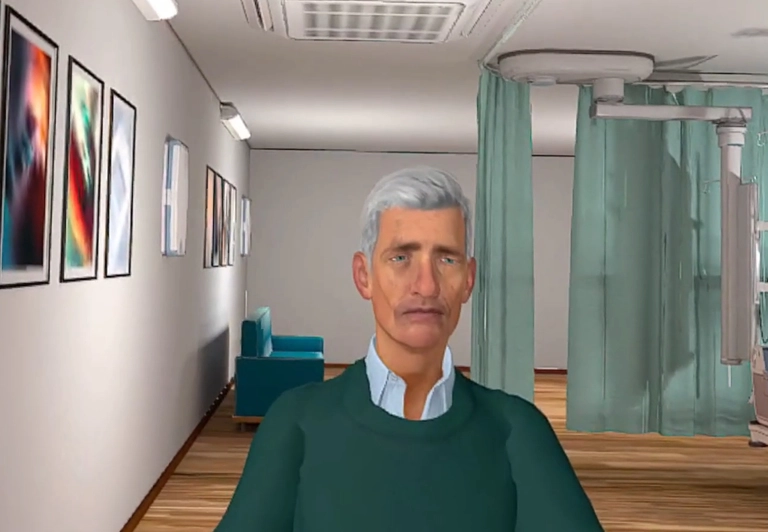
Employee and leadership performance reviews
Managers can practice difficult feedback sessions, conflicts, goal-setting meetings, or sensitive personnel discussions. Virtual conversational partners can represent different personality types, reactions, and escalation levels. As a result, users not only learn theoretical communication techniques, but also experience their effects firsthand.
Sales and Consulting
I'm Sales objection handling, needs analysis, advisory meetings, or complex product presentations can be simulated. The virtual customer can ask questions, react skeptically, or respond particularly positively or negatively to certain arguments. In this way, a company can not only convey conversation guidelines, but also make them practically trainable.
Medicine and nursing
Conversations with patients, family members, or colleagues are among the most demanding communication situations of all. Immersive training can, for example, simulate informed consent discussions, difficult patient situations, intercultural communication, or medical terminology.
With EmpathAI Design4real has already developed an AI-powered specialized language and communication training program for people with a migration background in the medical and nursing sectors. Users practice real conversation situations with virtual characters and receive feedback on their statements.
Customer service and complaint management
Dissatisfied customers, misunderstandings, and emotional conversation scenarios can be realistically depicted in VR without endangering real customer relationships. Employees can test different conversational strategies and learn to remain calm and solution-oriented even under pressure.
Presentation and public speaking
VR is also suitable for presentation training, facilitation, and public speaking. Virtual listeners, meeting situations, or larger audiences can be simulated. Depending on the application, eye contact, speaking pace, pauses, choice of words, or other parameters can also be evaluated.
Why Virtual Reality instead of traditional role-playing?
Roleplays with trainers or colleagues are effective, but organizationally complex and only scalable to a limited extent. In addition, many participants find it difficult to establish a realistic conversation scenario within familiar teams.
VR creates a standardized training environment. Every participant can experience the exact same situation, training levels can be compared, and scenarios can be repeated as often as desired. At the same time, the experience is more personal than a video or a purely text-based chatbot, because users encounter a virtual counterpart spatially and socially.
Another advantage is repeatability. A difficult conversation can be practiced multiple times, allowing different strategies to be tested. This turns a one-time training session into an iterative learning process.

What role does AI play?
AI is not the actual training goal, but a tool within the system. The crucial factor is how it is used didactically.
Possible functions are:
- Speech recognition and transcription of the statements
- semantic analysis of the conversation content
- Identification of relevant key terms or conversation strategies
- Assessment of tone and phrasing
- Selection of suitable responses from the virtual conversation partner
- individual feedback or evaluation logic
- Difficulty adjustment
- multilingual support or hints
For mission-critical training, we prefer a controllable architecture. Training managers must be able to understand why a scenario triggers a specific response. Departmental units must be able to help determine conversation flows, learning objectives, and permissible response ranges.
Free AI or controlled conversation logic?
A completely freely generating AI avatar sounds particularly flexible at first. For professional training, however, maximum openness is not always the best solution. If responses are technically incorrect, inappropriate, or not reproducible, the training effect can suffer.
That is why a hybrid approach can make sense: AI analyzes user input, while the actual responses come from verified conversation paths, response modules, or defined behavioral rules. This keeps the experience dynamic while keeping content controllable and repeatable.
At EmpathAI, Design4real pursues precisely this approach: conversation scenarios should be editable, testable, and capable of being iterated by experts themselves. The technical platform thus serves not only as a training application, but also as a tool for developing and maintaining custom scenarios.
Custom scenarios instead of standard library
Communication training works particularly well when the situations match the actual working reality. A generic sales pitch is of limited help when a company sells complex machinery, pharmaceutical products, or technical services.
Design4real therefore develops customer-specific scenarios. Together with specialist departments, we define roles, conversation goals, typical mistakes, critical statements, alternative courses, and evaluation logics.
Existing training materials, conversation guidelines, SOPs, training documents, or real-life case studies can be incorporated into the design. On this basis, a storyboard is created, which is then technically translated into an interactive training system.

How does a project work?
Define training goal and target audience
At the beginning, it is clarified which specific behavior is to be improved. Examples include empathy, conversation structure, handling objections, medical terminology, leadership communication, or conflict resolution.
Develop conversation scenarios
Together with the subject matter experts, realistic situations, roles, and potential courses of action are developed. The decisive factor is not the number of dialogues, but the quality of the situations and their relevance to everyday work.
Design avatar and environment
Depending on the goal, the training can take place in a meeting room, clinic room, sales floor, office, or other realistic environment. Virtual characters are designed and animated to match their roles.
Integrate speech and AI system
Speech recognition, analysis, dialog logic, and feedback are technically linked together. In doing so, we pay attention to Latency, comprehensibility, reproducibility, and data protection requirements.
Pilot and optimize
An initial pilot with selected users quickly shows whether conversation flows, difficulty level, and feedback work. Based on these tests, scenarios and evaluation logic are iteratively adjusted.

Data protection and technical architecture
In AI-powered communication training, it must be clarified early on which data is processed. Voice recordings, transcripts, or training evaluations may contain personal information. Therefore, it should be determined already in the conceptual phase which data is actually needed, where it is processed, and how long it is stored.
Depending on the project, cloud services, European providers, custom backend structures, or combinations thereof can be used. Not every training session requires the permanent storage of audio data or complete conversation logs. Often, the architecture can be designed to be data-minimal.
Design4real therefore plans the technical architecture together with the customer, taking into account corporate IT, data protection, desired hosting models, and integrations into existing learning systems.
VR, mixed reality, or tablet?
Not every communication training has to run exclusively in VR. Depending on the rollout, the same training logic can also make sense on a tablet, desktop, or other devices.
VR offers the highest degree of presence and is particularly suited for emotionally demanding situations, spatial contexts, and intensive role-play training. Tablet or desktop variants, on the other hand, can provide low-threshold access and a broader reach.
EmpathAI demonstrates that a training system can be deliberately designed to be cross-platform. Therefore, it can make sense for companies to first develop a particularly immersive VR module and later expand the scenario system to additional end devices.
For which companies is an AI-powered VR communication training suitable?
The approach is particularly interesting for companies and organizations where the quality of conversations has a direct impact on safety, customer satisfaction, sales success, or leadership. These include, among others, Healthcare and care, pharmaceuticals, industry, technical sales, customer service, further education, public institutions, and larger human resources development programs.
Even in the face of skilled labor shortages and internationally diverse teams, such a system can offer advantages. Linguistic and communicative requirements can be practiced in realistic professional contexts rather than being taught exclusively in the abstract.

Why Design4real?
Design4real has been developing immersive training and XR applications for businesses for many years. Our strength lies in the combination of technical XR development, 3D and avatar production, interaction design, and the integration of modern AI and voice systems.
With EmpathAI, we have already built our own platform for AI-powered communication training and tested it in real-world training situations. This allows us not only to provide theoretical consulting, but also to apply experience from conception, avatar interaction, speech processing, scenario development, and user feedback to new projects.
The goal is not to use AI for its own sake. The crucial factor is a training system that can be sensibly operated, expanded, and content-controlled for the respective organization.
Matching services: Virtual Reality · EmpathAI: AI-powered Technical Language Training · Virtual reality in public speaking training
Further sources: European Commission – Artificial Intelligence Act / Regulatory Framework

Frequently Asked Questions about VR Communication Training with AI
The user speaks with a virtual character. Speech is recognized and analyzed. Depending on the training concept, the avatar reacts dynamically or based on defined conversation paths. Afterwards, individual feedback can be provided.
No. For professional training, a hybrid approach often makes more sense. AI can analyze statements, while verified responses and defined conversation logic ensure control, reproducibility, and professional quality.
Yes. Customized scenarios are a core component of such projects. Interview guides, typical cases, training materials, or existing learning objectives can serve as a basis.
No. Depending on the project, the same training logic can additionally be offered on tablet or desktop. However, VR offers a high level of presence, especially in emotional or spatially relevant conversation situations.
That depends primarily on the scope, number of scenarios, avatar quality, AI logic, and desired platforms. For a clearly defined pilot, an initial representative scenario can be developed and tested before adding further content.
Yes. The application can be integrated as a supplementary training module into existing learning or personal development programs. Interfaces to learning platforms, user management, or reporting can also be provided on a project-specific basis.
Let's talk about your project.
Whether Virtual Reality, Augmented Reality, or WebAR: We provide tailored advice and develop immersive applications that fit your brand and target audience. Free initial consultation, personal and at eye level.
+49 179 3927971 · info@design4real.de · Lindwurm St. 95a, Munich