

AI AVATARS IN VIRTUAL REALITY
Intelligent conversational partners for immersive applications
AI avatars in virtual reality combine two technologies that complement each other exceptionally well: immersive 3D worlds and artificial intelligence. Instead of interacting with a static figure, a traditional menu, or a pre-recorded sequence, users can stand face-to-face with a digital character, speak to them, and respond to their reactions. The avatar thus transforms from a purely visual element into an active component of the application.
AI Avatars in Virtual Reality at a Glance
Design4real develops customized VR and XR applications for businesses, integrating intelligent avatars, voice-based interaction, and AI-powered dialogue systems upon request. For us, the key is not to incorporate as much generative AI as possible, but rather to develop a technically stable, content-controllable solution that makes sense for the respective application purpose.


What is an AI avatar in virtual reality?
An AI avatar is a digital character that is visible, responsive, and interactive in a virtual environment. The representation can be realistic, stylized, or deliberately abstract. Unlike traditional NPCs with fixed dialogues, an AI avatar can understand language, respond to user input, and trigger different answers or actions depending on context, role, and application.
Technically, such a system usually consists of several components: speech recognition converts the user's utterance into text or semantic information. Dialog logic or a language model processes the input. An answer is then selected or generated. Text-to-speech produces the spoken output. In parallel, the face, lip movement, gestures, gaze direction, and, if applicable, body animation are controlled.
Modern platforms show how strongly these building blocks can now be combined modularly. For example, NVIDIA describes digital humans as an interplay of language understanding, speech synthesis, AI models, animation, and real-time graphics. With technologies like Audio2Face, audio can be converted directly into facial animation and Lip syncing be used for a 3D avatar. (Source: nvidia.com)
Why virtual reality is especially interesting for AI avatars
A voice assistant on a screen remains a Interface. An avatar in VR, on the other hand, can be perceived as a counterpart. Users stand spatially opposite the character, hear the voice from the right direction, recognize facial expressions and gestures, and can relate to them spatially. This creates social presence.
This spatial presence is particularly relevant in training, consulting, and simulation applications. For example, an avatar can act as a customer, patient, colleague, supervisor, trainer, visitor, or virtual product expert. The application thus creates a situation in which users not only retrieve information, but actually have to act and communicate.
Body design also plays an important role. In its current VR design guidelines, Meta describes that avatars should credibly represent position, movement, and gestures so that they are perceived as natural and comfortable in immersive environments. (Source: developers.meta.com)

Typical use cases for AI avatars in companies
Virtual conversation partners for training and professional development
An AI avatar can depict conversation scenarios that are difficult to train in traditional e-learning. Examples include patient consultations, sales pitches, employee reviews, service situations, de-escalation, or intercultural communication. The avatar's reaction can vary depending on the user's statement.
An important question in this context is how openly the system should react. For sensitive training scenarios, completely free generation is often not recommended; instead, a controlled architecture is preferable. For example, the AI can analyze statements and then select a suitable, predefined response. This keeps the learning objective, tone, and dramaturgy controllable.
Virtual advisors and product experts
In product presentations, virtual showrooms, or Messaging apps Can an AI avatar act as a digital product expert? Users ask questions and receive answers regarding features, use cases, or product variants. The avatar can additionally activate 3D models, highlight components, or open content in the space.
Especially with products that require explanation, this creates a combination of conversation and visual demonstration. The avatar doesn't just explain how a product works, but can directly show what is meant.
AI Hosts for Virtual Experiences
An avatar can guide users through a VR application, explain contexts, pose tasks, or react to progress. In contrast to a fixed voice-over, the guidance can become interactive. The user decides for themselves when to ask questions or which topic area they want to explore in more depth.
Simulation of customers, patients or colleagues
For realistic role-playing games, digital characters can be equipped with different roles, personalities, and communication patterns. A virtual patient reacts differently than a customer in Sales. An insecure employee requires different conversation strategies than an aggressive communication partner.
This role logic makes it possible to build many variants of a scenario on the same technical basis.
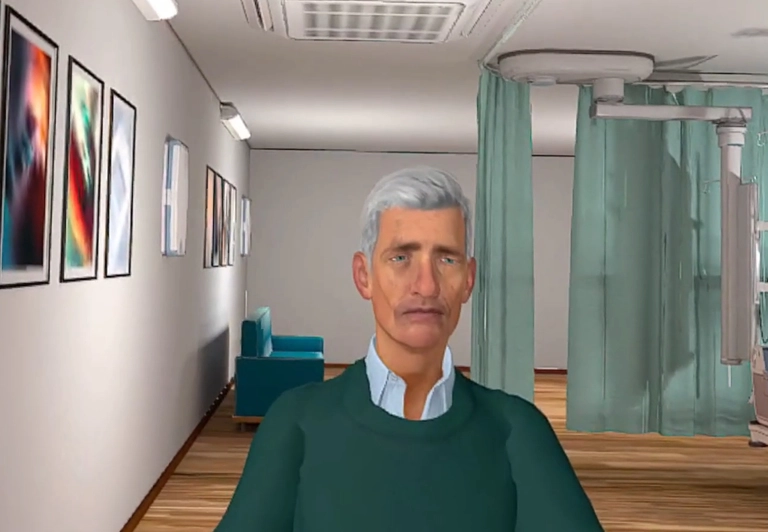
EmpathAI: AI avatars already in a real Design4real project
With EmpathAI Has Design4real already developed an immersive application where users can communicate with virtual persons? The system is designed as AI-assisted technical language training and is aimed, among others, at people with a migration background in the medical and nursing environment.
In a realistic virtual environment, users practice conversation scenarios with digital avatars. The goal is not only language, but also the social and empathetic component of the conversation. The public project description already shows the combination of virtual reality, AI support, and interactive avatars.
This experience is particularly relevant for new projects because AI avatars are not just an LLM topic. A compelling application also requires scenario design, 3D characters, animation, audio, UX, VR interaction, system integration, and a clean dialogue architecture.
Generative AI or controlled dialogue logic?
Not every application benefits from completely free AI responses. In many enterprise projects, it is more important that content remains factually correct, reproducible, and verifiable.
The appropriate architecture depends on the application area. In the case of a trade fair stand, an unrestricted product expert may make sense. In the case of medical or safety-critical training, on the other hand, a more strictly controlled reaction logic is often preferable.
- Fully scripted dialogues: maximum control, but low flexibility.
- Rule-based branching: User utterances are assigned to categories and trigger defined reactions.
- AI-supported classification: a language model evaluates the statement, but the answer itself remains predefined.
- RAG-based answers: the AI draws on approved knowledge sources to formulate an answer.
- Free-form generative dialogues: maximum flexibility, which in turn places higher demands on guardrails, prompting, and quality assurance.
Language, voice and lip-sync
For an avatar to seem believable, the technical pipeline must react quickly. Long waiting times destroy the conversation dynamics. Therefore, speech recognition, AI processing, text-to-speech, and animation must be orchestrated so that the response occurs as immediately as possible.
When it comes to the voice, tonality, age, language, and role play a part. For international applications, multilingual systems can be useful. In addition, automatic translation can be integrated.
Facial animation can be controlled via pre-made animations, blendshapes, viseme-based lip-syncing, or AI-based methods. NVIDIA cites Audio2Face as an example of automatic animation of digital faces based on an audio signal.

Realistic or stylized avatar?
Photorealism is not automatically better. Highly realistic digital humans raise expectations regarding skin, eyes, hair, facial expressions, and animation. Even minor flaws can then appear unnatural.
For many business applications, a high-quality stylized character is the more robust solution. The crucial factor is that appearance, voice, behavior, and application purpose must match. For example, a training avatar can be deliberately designed to be neutral, while a brand host can be more closely aligned with the corporate design and brand world.
Design4real can, depending on the project, create avatars using existing character pipelines, individualized 3D models, Motion Capture, implement facial animation and real-time engines.

Unity, Unreal and technical integration
AI avatars can both in Unity– as well as in Unreal-based applications. The choice of the engine depends on the existing project, the visual requirements, the target devices, and the existing 3D assets.
The AI components are typically connected via APIs or local services. It should be clarified early on which information may be transmitted to external systems, which data is stored, and whether parts of the processing must take place locally.
For companies, it is also relevant how the system will be operated later: on individual headsets, in a centrally managed device fleet, locally in the company network, or with cloud components.
Data protection and governance for AI avatars
As soon as speech is processed, personal or sensitive content can be generated. Therefore, it must be clarified during the design phase already which data are actually needed.
Design4real does not view these points as an afterthought, but rather as part of the system architecture. Especially when it comes to Healthcare—For HR or training projects, the technical solution should be adapted to data protection, governance, and the actual implementation process.
- Is the audio being saved, or is it just being processed temporarily?
- Are transcripts saved?
- Which external AI or speech services are used?
- Where does the processing take place?
- Are user data used for model training?
- How are sensitive conversation contents protected?
- What answers is the system allowed to give, and which ones is it not allowed to give?
AI Avatar as Part of a Larger XR Application
In most projects, the avatar is not the entire application. It is an interactive component within a larger scenario. This can include 3D environments, products, machines, data visualizations, Hand tracking, multi-user features, Gamification or training reports.
This is what sets a custom-developed XR solution apart from a simple web avatar or chatbot. The AI must understand what is happening in the virtual space. For example, an avatar can point to an object, activate a machine, guide the user to a location, or respond to an action that was previously performed.


Here's How Design4real Develops AI Avatars in VR
We start with a specific use case. We define the avatar’s role, target audience, conversational context, and desired level of flexibility. We then develop the technical architecture and decide which components will be implemented locally, in the cloud, or via external APIs.
This is followed by character design, 3D environment, speech pipeline, dialogue logic, and interaction. Already in early prototypes, we test Latency, comprehensibility and conversation dynamics. Especially in AI projects, this iterative process is more important than a long specification on paper.
For complex applications, a proof of concept can be useful at first. This makes it possible to check with manageable effort whether the desired conversation quality, response speed, and avatar impact are achieved.
Have Custom AI Avatars Developed for Your Business
AI avatars in virtual reality open up new possibilities for training, consulting, simulation, and interactive product communication. However, the added value does not come from the avatar alone, but rather from the combination of a believable character, well-designed dialogue, reliable real-time technology, and a clearly defined use case.
Design4real combines years of XR experience with cutting-edge AI technologies and real-world project experience from applications like EmpathAI. If you would like to explore how an intelligent digital conversational partner can be implemented in your company, we will work with you to develop a suitable prototype or a complete XR application.
Matching services: EmpathAI: AI-powered Technical Language Training · Virtual Reality
Further sources: Modern platforms demonstrate just how flexibly these building blocks can now be combined in a modular way. NVIDIA, for example, describes digital humans as the interplay of speech understanding, speech synthesis, AI models, animation, and real-time graphics. With technologies like Audio2Face, audio can be used directly to animate the face and synchronize the lips of a 3D avatar. Source · The design of the body also plays an important role. In its current VR design guidelines, Meta describes that avatars should credibly represent position, movement, and gestures so that they are perceived as natural and comfortable in immersive environments. Source

Frequently Asked Questions About AI Avatars in Virtual Reality
The costs depend heavily on the scope. Relevant factors include avatar quality, number of scenarios, speech processing, AI architecture, animation, target hardware, and desired integrations. A clearly defined proof of concept is significantly cheaper than a full training platform with multiple characters and evaluation.
Yes. Fully free generative dialogues are technically possible. For many enterprise applications, however, we recommend a controlled architecture with approved knowledge, guardrails, or predefined response paths.
In many cases, yes. Existing characters can be reviewed, optimized for real-time, rigged, and enhanced with facial and speech animation. The technical quality of the source model is the deciding factor.
Partially. Rendering and avatar logic often run locally on the client device. Depending on the architecture, language models and speech services can be operated either locally or cloud-based. For offline scenarios, the system architecture must be specifically designed for it.
That depends on the application, performance requirements, and operating model. For enterprise projects, in addition to graphics performance and tracking, we also consider device management, kiosk mode, hand tracking, support, and fleet operations. Therefore, headset selection should only take place after defining the use case.
Yes. In addition to technical implementation, we also develop interaction concepts, storyboards, dialogue structures, and role logic. Especially in training applications, the combination of didactic structure and technical implementation is crucial.
Let's talk about your project.
Whether Virtual Reality, Augmented Reality, or WebAR: We provide tailored advice and develop immersive applications that fit your brand and target audience. Free initial consultation, personal and at eye level.
+49 179 3927971 · info@design4real.de · Lindwurm St. 95a, Munich