

XR FOR PHARMA AND HEALTHCARE
Making medical content interactive and engaging
XR for pharma and healthcare can communicate complex medical relationships in a spatial, interactive, and understandable way. Drug mechanisms of action, clinical pictures, anatomical processes, or patient consultation scenarios can not only be explained, but designed as a digital experience.
XR for Pharma and Healthcare at a Glance
Such an application does not necessarily have to mean Virtual Reality.
Depending on the target audience and location, virtual reality, mixed reality, interactive real-time 3D applications, touchscreens, or other digital formats may be the more suitable solution.
Design4real develops individual XR and real-time 3D applications for Pharmaceutical companies, Healthcare organizations and medical Training scenarios and training courses. On our existing medical page, we already display various medical papers from areas such as cardiovascular diseases, osteoarthritis, type 2 inflammation, PCOS, and training in nursing.
Our projects too EmpathAI and Imagine demonstrate how different immersive media can be used in the healthcare context: from specialist language and Communication training up to the simulation of situations from everyday nursing care. An in-depth overview of this field of application can be found in our article VR training in medicine and nursing: training and further education.
The crucial question is therefore not „How do we bring this content into VR?“, but rather:
What medical or communicative content should be made more understandable, trainable, or experiential for which target audience?
Only then does the appropriate technological solution emerge.

Where can XR applications be used in pharma and healthcare?
The possible applications range from medical communication and training to events and internal training sessions.
A distinction should be made here between applications for communication and further education and XR systems with an actual diagnostic or therapeutic function.
This distinction is important.
As soon as XR becomes part of a medical diagnosis or treatment, regulatory requirements for medical devices can become relevant. Many of Design4real's projects, on the other hand, are in the areas of communication, training, visualization, and knowledge transfer.
Mode of Action – Explaining mechanisms of action spatially
A classic use case for pharmaceutical companies is the illustration of a mode of action.
The mode of action of a drug often takes place at a level that people can neither see directly nor understand intuitively.
Receptors, molecules, cells, signaling pathways, or inflammatory processes are therefore traditionally explained using illustrations, animations, or films.
Interactive real-time 3D applications can create an additional access point.
For example, users can:
- view anatomical structures in 3D,
- zoom into tissues or organs,
- Track disease processes step by step,
- highlight relevant cell types,
- visualize the sites of action of a drug,
- comparing different states,
- Access information interactively.
In Virtual Reality, the user can fully immerse themselves in such a medical visualization.
On a touchscreen or large display, however, the same content can be viewed and discussed together with other people.
Which form is more suitable depends heavily on the communication situation.
Pharma communication at congresses and trade fairs
Medical Congresses and Pharma trade shows place special demands on digital applications.
The content can be scientifically complex, while at the same time many exhibitors are competing for attention.
Therefore, an application must be visually interesting on the one hand and correctly convey the technical message on the other.
Right here, interactive 3D applications can offer an advantage over a purely linear presentation.
A visitor can investigate a disease process themselves or select various information.
The sales or medical affairs representative can use the application simultaneously as a conversation tool.
Not every pharma trade show needs VR goggles
In pharma and healthcare, we also pursue a technology-neutral approach.
VR can be very effective when complete immersion is desired.
However, if as many people as possible should see content at the same time, a large interactive screen can represent the better solution.
For a trade fair stand, for example, the following are possible:
- interactive touchscreen applications,
- real-time 3D medical visualizations,
- spatial mixed reality dioramas,
- Quiz and gamification concepts,
- Virtual reality experiences,
- large screen installations,
- Tablet applications.
The goal is not to place a specific technology at a certain level.
The goal is to convey technical content in a way that generates attention and subsequently supports a conversation.


Mixed Reality for Medical 3D Visualization
Mixed Reality can become particularly interesting when anatomical or medical content needs to appear as spatial models within the real environment.
For example, a user could view a virtual organ on a real table and walk around this model.
A disease process could become visible within the organ.
Subsequently, individual layers could be hidden or enlarged.
The real environment remains visible in the process.
This can be interesting for conferences or moderated presentations because the user is not completely cut off from their surroundings.
Even small spatial dioramas are possible.
For example, an application could represent different stages of a patient journey as three-dimensional scenes on a table surface.
The advantage of mixed reality does not lie solely in the visual effect.
Spatial relationships can actually become easier to understand when information appears where it belongs contextually.
VR Training for Healthcare and Nursing Care
A second major area is training.
Healthcare professions do not just consist of medical expertise. Communication, decision-making, and behavior in specific situations also play an important role.
Virtual reality makes it possible to simulate such situations in a controlled environment.
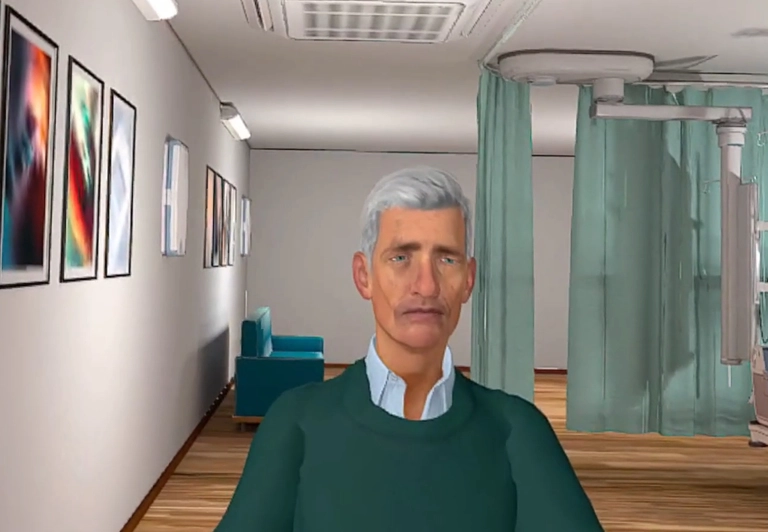
Design4real already has a VR Training implemented for nursing and elderly care staff. The application simulates everyday care situations and combines virtual patients with interactive decisions and realistic environments.
Another approach is EmpathAI.
The system was developed as an AI-supported specialized language training for people with a migration background. Users practice medical terminology and conversation situations in a virtual environment.
These examples show two different levels of immersive learning:
procedural learning – What do I have to do in a specific situation?
and
Communicative learning – How do I speak and react in a specific situation?
Especially the second category can be particularly relevant in healthcare.

Practice conversation scenarios with virtual patients
Communicating with patients is often difficult to train using traditional learning media.
A text describes a situation, but does not react to the learner.
A video shows a process, but does not let the viewer act themselves.
Virtual conversation scenarios, on the other hand, can require an active role.
The user must listen, process information, and select or formulate a response.
Depending on the training system, different responses can be triggered.
Such an application does not necessarily have to be built as a fully open AI simulation.
Especially in technically sensitive areas, it can be useful to define potential reactions and learning paths in a controlled manner.
This ensures that medical and didactic statements remain comprehensible.
- Nursing communication,
- Anamnesis,
- Consultations,
- Dealing with relatives,
- difficult conversation situations,
- intercultural communication,
- medical terminology,
- Empathy and soft skills.

Medical content must be professionally validated
In healthcare projects, visual quality alone is not sufficient.
An anatomically impressive depiction can still be technically incorrect.
Therefore, the development of medical XR content must be closely coordinated with the relevant professionals of the client or medical experts.
Design4real is responsible for concept design, interactive design, 3D production and technical development.
The professional validation of medical statements is carried out in collaboration with the experts responsible for them at the customer’s company.
This applies, for example, to:
- Anatomy,
- Pathophysiological mechanisms,
- Mechanisms of action,
- medical terminology,
- Contents of conversations,
- Treatment paths,
- Regulatorily relevant statements.
Especially at Pharma-Communication should also be clarified early on regarding which content is available to which target group.
An application for medical professionals may contain different information than an application for patients or the general public.
From medical data to interactive 3D applications
The initial data of medical projects differ significantly from traditional industrial projects.
While Mechanical engineering companies Often CAD data is provided, and in the healthcare sector there can be different sources available.
From these materials, we develop the assets required for the application.
In this process, the visual style that suits the project is decided early on.
Medical visualization does not always have to be photorealistic.
In some cases, a simplified presentation is even more understandable because irrelevant details can be reduced and central structures can be highlighted more clearly.
- existing medical illustrations,
- 3D anatomical models,
- scientific animations,
- Image material,
- Storyboards,
- released medical claims,
- Training materials,
- Scientific references.
Real-time 3D instead of linear animation
Many pharmaceutical companies already have high-quality medical films and animations.
These remain useful for numerous communication tasks.
A real-time application, however, follows a different principle.
The user does not have to follow a fixed camera route.
He can decide for himself which area he considers or which information he calls up.
This allows a linear content to be transformed into an exploratory experience.
For example, an existing 3D model from a medical animation could be repurposed for a real-time application.
Whether existing assets can actually be reused must be technically examined.
Offline rendering models often have a significantly higher level of detail than real-time applications and require appropriate optimization.

Data protection and sensitive information
Healthcare projects can involve personal and health data.
However, not every medical XR application requires personal data at all.
A fashion-of-action visualization or a generic training scenario can, for example, work completely without real patient data.
From a technical and data protection perspective, this is often the simplest solution.
If user data, voice recordings, performance data, or other personal information are to be processed, it must be clarified during the design phase:
Which data are actually needed?
Where are they processed?
Who can access it?
How long will they be stored?
Which external services are being integrated?
Can the application also work with less or no personal data?
Data sparsity should therefore be part of the system architecture from the outset and not be considered only after the application is completed.

Is an XR application automatically a medical device?
No.
An XR application does not become a medical device solely because it displays medical content.
In particular, purpose and function are crucial.
An interactive visualization for a medical exhibition booth differs fundamentally from a system intended, for example, for diagnosis, therapy, or specific medical decisions.
Once an application receives such a medical purpose designation, the regulatory classification must be examined in a timely manner by appropriately qualified bodies.
Design4real is a development partner for immersive and interactive applications. The regulatory approval of a medical device, however, is a separate and technical task.
This separation should be clearly defined at the beginning of the project.
XR for Pharma and Healthcare develops with Design4real
Design4real combines design, 3D design, real-time development, and years of experience with immersive media.
For pharmaceutical and healthcare projects, very different solutions can result from this.
A project can be a five-minute MRI application at a congress.
Another option could be extensive communication training for caregivers.
A third project can convey a medical mechanism of action as an interactive 3D world.
That is why development does not start with a fixed technology.
Define the target group and communication goal
First, we need to determine who will be using the application.
Healthcare Professionals?
Patients?
Nursing staff?
Medical Affairs?
Trade show visitors?
The target audience reveals itself in terms of content, language, complexity, and the user interface.
Structuring technical content
Together with the medical contact persons, we define which statements need to be conveyed.
For complex topics, we develop a storyboard or an interactive dramaturgy.
Select the appropriate technology
Afterwards, we decide whether VR, MR, a touchscreen, a tablet, or another real-time 3D solution is worthwhile.
Especially for trade show and congress applications, we also consider throughput, support, hygiene, and visibility for passing visitors.
3D production and development
After that, medical 3D assets, user interfaces, animations, and interactions are created.
Depending on the project, audio, virtual characters, Hand tracking or integrated with speech-based interaction.
Professional review and testing
Medical content is reviewed by the relevant subject matter experts.
In parallel, we are testing user experience, performance, and technical stability.
Deployment and Expansion
The application is provided for the intended target platform.
In modularly structured projects, additional content, language versions, or scenarios can be added later on.
What does an XR application for pharma and healthcare cost?
The costs depend heavily on the content and the technical complexity.
A compact interactive 3D visualization requires more effort than a fully walkable VR world with virtual patients, speech interaction, and multiple training paths.
In larger projects, a pilot can be useful.
This allows one to first implement a single mechanism of action, a conversation situation, or a market use case and test it with the target audience.
- Scope of 3D production,
- existing assets,
- Number of scenes,
- Scope of interaction,
- Animations,
- virtual characters,
- Speech functions,
- Multilingualism,
- Target platforms,
- necessary interfaces,
- Evaluation functions,
- Scope of testing and review.
Start of XR project for Pharma or Healthcare
Do you want to explain a medical connection interactively, develop an immersive application for a congress, or train healthcare staff in realistic situations?
Design4real supports you from the initial use case analysis through storyboarding and 3D production to the technical development of the finished application.
In the process, we first determine which technology is actually useful for the project.
Talk to us about your medical content and your target audience. Together, we will develop an interactive application that makes complex relationships understandable and relatable.

Frequently asked questions about XR for Pharma and Healthcare
The costs depend on the 3D scope, interactions, target platform, existing assets, and required functions. A focused medical 3D visualization is significantly less complex than an extensive training system with avatars, voice, and multiple scenarios. After receiving a concrete briefing, Design4real can reliably estimate the effort.
Often yes. Existing 3D assets can be optimized for real-time applications after a technical review. However, models from traditional rendering pipelines are often too complex and must be reduced and re-prepared for VR, MR, or mobile hardware.
No. Depending on the communication goal, touchscreens, large displays, tablets, Web3D, or mixed reality may be more suitable. Especially at trade shows, the technology should be chosen based on how many people are to be reached and how the application is integrated into the conversation at the booth.
Yes. Many applications for medical visualization, training, or pharma communication do not require real patient data at all. If personal or health data is to be processed, however, data protection and system architecture must be taken into account early on.
No. What matters are the intended purpose and function. A communication or training application is not automatically equivalent to a diagnostic or therapeutic medical device. In the case of a medical intended purpose, the regulatory classification should be examined at an early stage by appropriately qualified experts.
A focused prototype or trade fair use case can be realized within a few weeks. Extensive VR training or interactive medical applications can take several months. The specific schedule depends in particular on 3D production, the scope of interaction, review processes, and approvals.
Let's talk about your project.
Whether Virtual Reality, Augmented Reality, or WebAR: We provide tailored advice and develop immersive applications that fit your brand and target audience. Free initial consultation, personal and at eye level.
+49 179 3927971 · info@design4real.de · Lindwurm St. 95a, Munich