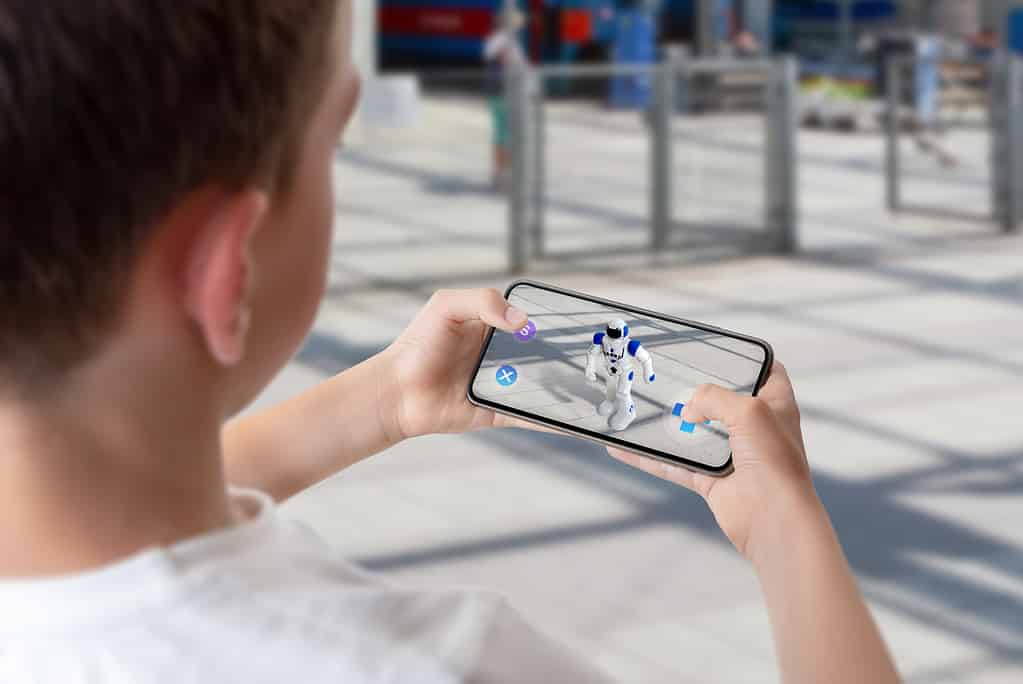
Provide your audience with immersive experiences, customized for your brand. Use elements like gamification to engage customers and drive valuable actions.
Gamification refers to the application of game-like elements and design principles in non-game contexts to increase engagement, motivation, and the learning experience. That is, game-like aspects are introduced in a situation not normally considered a game to increase user engagement and interest.
By combining AR and gamification, developers and designers can create immersive and entertaining game experiences in the real world. Here are some examples of how they can work together:
AR portals are digital entrances or transitions embedded in the real world and created using augmented reality technology. Users can enter and interact in virtual environments through these portals. For example, AR portals could be placed in prominent locations in the real world, and when a user points their smartphone or AR glasses at them, they are transported into an AR game world or other virtual experience.
Minigames in AR are small, standalone games or challenges embedded in the player's real-world environment. Players can play these games on their mobile devices or AR-enabled devices by using the environment around them. For example, these mini-games can be puzzles, riddles, collection games, or action games designed specifically for AR to link the gaming experience to the physical world.
Virtual scavenger hunts are modern versions of the classic scavenger hunt, where players use AR or other technologies to find and solve clues and tasks in the real world. Participants follow a series of clues hidden in various physical locations to reach the goal of the scavenger hunt. This type of activity can be both fun and educational and is often used in recreational and educational contexts.
Education and learning applications can use AR to integrate interactive learning content with the real world. Immersion in an AR-based learning environment can increase student interest and motivation,
Companies can use AR gamification to engage customers in their promotions. For example, they could create AR scavenger hunts where customers find specific products in stores and receive virtual rewards.
With the help of WebAR the AR experiences can even be experienced without an app, directly in the smartphone browser.
At LEGOLAND Deutschland, AR can be used to bring the creatures of Lego MYTHICA to life. Visitors can use their smartphones to experience them in the real world.
With the help of AR, the M&Ms Music Lounge can be visited through a portal. There is a lot for users to explore, so they could compose their own beats, or create their own M&Ms.
A combination of augmented reality and gamification opens up a wide range of creative possibilities to create engaging and engaging experiences. Our real world merges with the virtual world and user engagement is increased through interactions.
The augmented reality agency Design4real supports you in the implementation of your AR experiences. We take care of planning, implementation and design for you. Use AR in combination with gamification and offer your customers an impressive AR experience.
Sie sind interessierst in die Entwicklung einer Augmented Reality oder 360° Tour Anwendung? Sie haben vielleicht noch Fragen zum Budget und Umsetzung. Melden sie sich gerne bei mir.
I am looking forward to you
Clarence Dadson CEO Design4real
Gamification refers to the application of game-like elements and design principles in non-game contexts to increase engagement, motivation, and the learning experience. That is, game-like aspects are introduced in a situation not normally considered a game to increase user engagement and interest.
Durch die Kombination von AR und Gamification können Entwickler und Designer immersive und unterhaltsame Spielerlebnisse in der realen Welt schaffen. Beispiele dafür sind AR-Portale, Minispiele in AR und virtuelle Schnitzeljagden, die das Spielerlebnis mit der physischen Welt verknüpfen.
AR-Portale sind digitale Eingänge oder Übergänge, die in die reale Welt eingebettet sind und mithilfe von Augmented-Reality-Technologie erschaffen werden. Benutzer können durch diese Portale in virtuelle Umgebungen eintreten und darin interagieren.
Minispiele in AR sind kleine, eigenständige Spiele oder Herausforderungen, die in die reale Umgebung des Spielers eingebettet sind. Diese Spiele können auf mobilen Geräten oder AR-fähigen Geräten gespielt werden und nutzen die Umgebung um den Spieler herum.
Virtuelle Schnitzeljagden sind moderne Versionen der klassischen Schnitzeljagd, bei denen Spieler mithilfe von AR oder anderen Technologien Hinweise und Aufgaben in der realen Welt suchen und lösen. Die Teilnehmer folgen einer Reihe von Hinweisen, die an verschiedenen physischen Orten versteckt sind, um das Ziel der Schnitzeljagd zu erreichen.

Companies can use AR gamification to engage customers in their promotions. For example, they could create AR scavenger hunts where customers find specific products in stores and receive virtual rewards.
WebAR ermöglicht es, AR-Erlebnisse direkt im Browser des Smartphones zu erleben, ohne dass eine spezielle App heruntergeladen werden muss. Dies macht den Zugang zu AR-Inhalten einfacher und zugänglicher für die Benutzer.
Design4real unterstützt bei der Planung, Umsetzung und Gestaltung von AR-Erlebnissen. Sie bieten maßgeschneiderte Lösungen, um ansprechende und einnehmende Erlebnisse zu schaffen, die die reale Welt mit der virtuellen Welt verschmelzen lassen.