Matterport vs Gaussian Splatting: Why Matterport is not true 3D
Why Matterport does not deliver what it promises
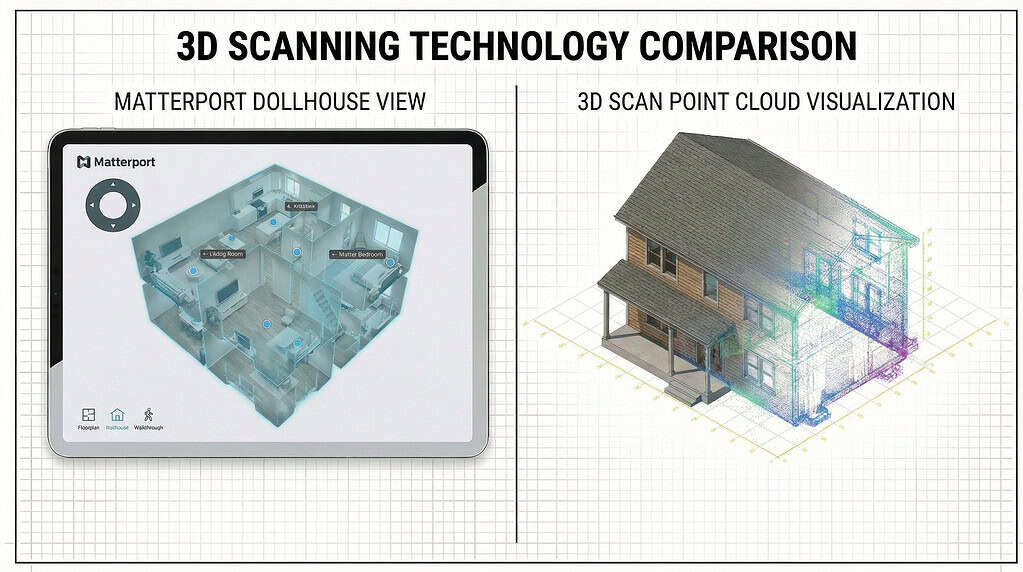
Many customers say: "We had our rooms scanned in 3D" But what you mean is Matterport... that's not a 3D scan! However, the technology does not quite live up to the promise of the term "3D". Matterport generates no real 3D structurebut a well-made 360° photo tour. You move from panorama to panorama, and between these points an artificial aperture is created that has no spatial continuity.
A real 3D scan - for example via Gaussian splatting - works completely differently. Here, a volumetric image of the room is created that enables free navigation, real parallax and realistic lighting conditions. This is precisely where the fundamental difference in the discussion begins Matterport vs Gaussian Splatting.
1. why Matterport does not create a real 3D model
Matterport is based on 2D panoramaswhich are recorded at fixed points in the room. These so-called hotspots form the entire navigation structure of the tour. Users can only move between these points and view the recordings there.
This means:
No free camera movement
No real depth structure
No continuous spatial representation
In comparison, Gaussian splatting generates a Volumetric modelthat can be explored from any angle. The spatial representation is not tied to fixed viewpoints, but results from the totality of the captured splats.
2. parallax, windows and reflections: The limits of image-based systems
An often overlooked point at Matterport: the Missing parallax. Windows often look flat, almost like posters. The reason is simple: a panorama only has a single shooting angle. The outside view is embedded as a flat image.
Reflections also behave unnaturally. They are "burned" into the panorama and do not react to the movement of the viewer. As soon as you move your head slightly to the side, the reflection remains static.
Gaussian splatting solves this problem because the scene is captured volumetrically. Light, reflections and depth information result from the position and density of the splats. This creates a realistic spatial impression that changes dynamically.
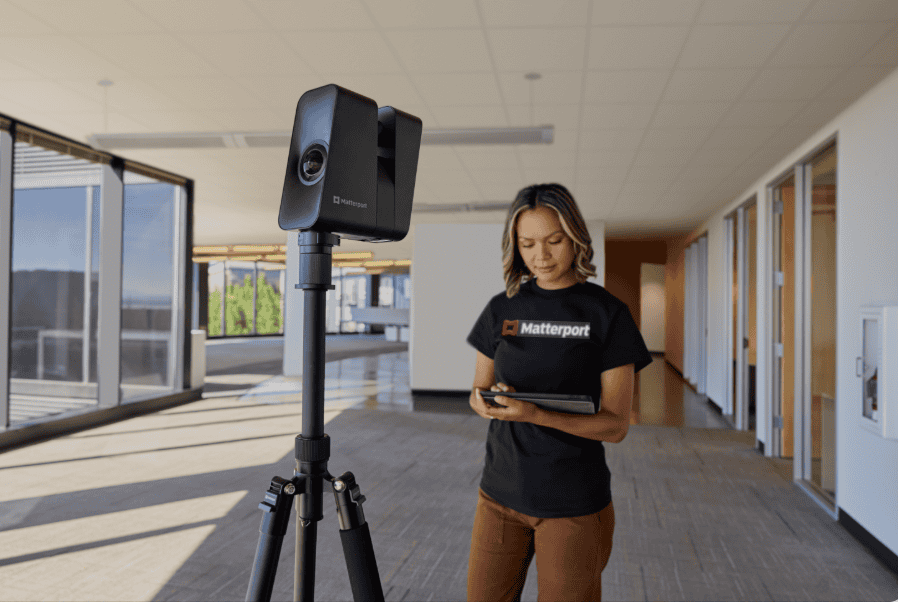
Matterport Scanner
Matterport Scanner
Matterport offers several of its own cameras, all of which are based on an image-based detection approach. The most important models:
Smartphone app (free of charge) For simple scans, but very limited in quality.
Matterport Pro2 (approx. 3,000-3,500 €) Classic panoramic camera that delivers high-quality 360° images, but still no real 3D model generated.
Matterport Pro3 (approx. 6,000 €) With LiDAR support, but the sensor is only used for orientation. The display remains photography-based, not volumetric.
Hardware for Gaussian Splatting 3D Scans
Gaussian splatting is hardware agnostic. Unlike Matterport, you are not tied to one camera model - there are several viable ways to create a splat model:
LiDAR-based 3D scanners (approx. €4,000-5,000) The most reliable results are provided by mobile LiDAR systems such as the Lixel K1 or comparable devices. They capture dense depth information and deliver very uniform splats.
DSLR or mirrorless cameras High-quality photo cameras can generate splats using photogrammetry workflows. The image quality is excellent, but the workflow is more complex and requires more post-processing.
360° cameras Cameras such as Insta360 or Ricoh models can also be shown. The quality is limited, but sufficient for simple projects or large outdoor shots.
Smartphones (incl. iPhone LiDAR) Modern smartphones with LiDAR - or pure camera recordings - can generate splats. The quality varies, but works surprisingly well for quick scans or smaller scenes.
3. restrictions due to lack of free camera movement
Navigation in Matterport follows strict rules: You only move between defined points. There is no real camera freedom.
This limitation has a particularly strong effect if you want to transfer Matterport to VR or interactive applications. The rigid navigation often leads to discomfort and appears artificial.
Gaussian splatting is more flexible at this point. The model can be:
explore freely in the room,
into Unity or Unreal Engine,
for VR, MR or WebAR,
for avatars and interactions.
The difference between Matterport vs Gaussian Splatting becomes particularly clear here: Matterport shows rooms. Gaussian splatting makes it possible to experience.
4. workflow comparison: hotspot scanning vs. mobile volumetric recording
A key difference lies in the Recording process.
Matterport: Recording from fixed viewpoints
Matterport cameras are traditionally mounted on a tripod. A panorama is recorded at defined positions. These points later become navigation nodes - and are also the single point of viewthat users can take later.
The system is designed to present selective perspectives. Areas that you do not want to show are simply not scanned.
Gaussian splatting: mobile recording of the entire room
In the Gaussian splatting workflow, the recording hardware - such as a Lixel K1 or another volumetric scan rig - moves freely through the scene. The data is captured over the entire area.
This creates:
a complete volumetric reconstruction
Free navigation in the final model
Authentic presentation from every angle
a space that is not curated, but complete
This approach is more honest and enables realistic exploration. Errors or gaps in the scan become visible - which is technically correct, but more demanding.
5. image-based representation vs. volumetric reconstruction
Matterport is based on Image data. The tour is essentially a photo-based 360° experience. When zoomed in, the images become blurred, just like a normal photo.
Gaussian splatting uses splats - small, elliptical points distributed in space. The model is created from millions of these splats.
Advantages:
Real spatial depth
Realistic parallax
Dynamic lighting behavior
Disadvantages:
if poorly scanned, semi-transparent areas are created
Individual splats may become visible
incomplete data is more apparent than with Matterport
With Matterport, a blurred photo remains a blurred photo. With Gaussian splatting, you can see the structure of the splats when in doubt - a natural effect of volumetric systems.
6. license dependency and data sovereignty
Matterport is a proprietary systemwhich only works in the Matterport cloud. Without a subscription, you lose access and the data is permanently stored on US servers.
This poses problems:
GDPR uncertainty
Lack of control over the data
Dependence on an American provider
Gaussian splatting, on the other hand, offers:
local storage
Hosting on EU servers
full ownership of the data
Open reusability in 3D pipelines
This independence is a key advantage for professional applications.
7. closed platform vs. open 3D pipelines
Matterport is technically and commercially closed. The export of raw data or its free further processing is severely restricted.
Gaussian splatting, on the other hand, is based on open formats such as PLY or LCC. These can be:
in Unity and Unreal Engine,
integrate into WebGL,
process in Blender,
for video production or VR.
This makes Gaussian splatting the more flexible and sustainable solution in the long term.
8. possible applications in VR, MR and WebAR
Matterport maps rooms, but is not suitable for immersive XR applications. The lack of parallax and hotspot navigation lead to artificial, limited VR experiences.
Gaussian splatting is against it:
XR-ready
WebGL-performant
usable for avatars
naturally experienced in VR
This creates a much more authentic experience, particularly in training, architecture or cultural mediation.
9. ease of use: no-code convenience vs. flexible but young technology
Matterport scores clearly on the subject of Ease of Use. The platform has been on the market for many years and offers an end-to-end guided no-code environment. Anyone can create a tour without any prior technical knowledge: Set up the camera, scan, upload, done. The cloud takes care of the rest - including stitching, navigation and hosting. Technically simple, but correspondingly limited.
Gaussian splatting is in comparison a still young technology. There is currently no fully-fledged no-code solution that matches the convenience and simplicity of Matterport. The workflow requires some technical understanding: data acquisition, conversion, rendering and integration into WebGL or an XR application. There are already tools that simplify many things - but a real out-of-the-box solution does not yet exist. If you need help creating real 3D tours, a complete XR agency like Design4real is at your side.
For users who have no interest in technology or customization and simply "just need a quick tour", Matterport is probably the more convenient choice in the short term. However, you pay for this convenience with Restrictions, ongoing fees, data dependency and severely limited 3D functionality.
Gaussian Splatting is a little more expensive - but in return you get real data sovereignty, complete freedom of display and no permanent subscription commitment.
Matterport is a visually appealing solution for simple tours, but not true 3D technology. The presentation is curated, image-based and technically limited.
Gaussian splatting, on the other hand, generates:
Real spatial depth
Free navigation
Realistic light and surface effect
Full data sovereignty
Gaussian splatting is therefore the clearly superior approach for modern XR applications, WebAR and immersive spatial representations.
Matterport creates a tour based on 2D panoramas with navigation via fixed hotspots. Gaussian Splatting, on the other hand, creates a volumetric model with a true 3D experience and free navigation.
Real spatial depth, free camera movement, data sovereignty, open formats and flexible choice of hardware and workflow.
Let us advise you.
Are you interested in developing a virtual reality or 360° application? You may still have questions about budget and implementation. Feel free to contact me.