

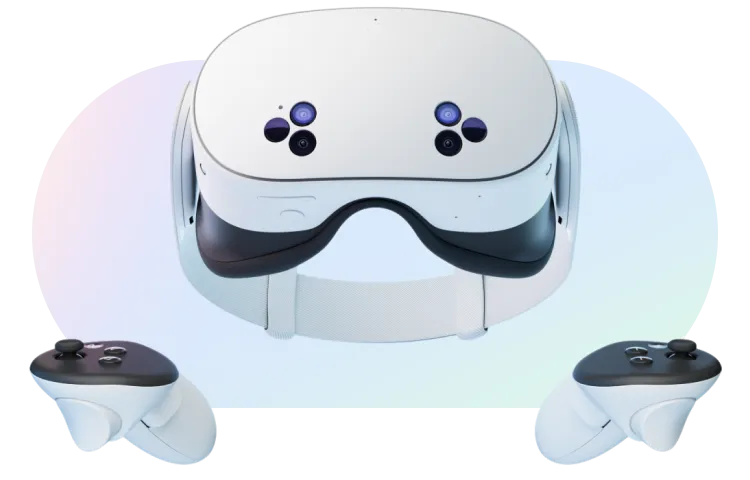
Updated on October 2, 2026: The Meta Quest 3S can be a good entry point into VR projects, but it is not automatically a ready-made business headset. Meta lists it in the German store for €359.99 (128 GB) and €469.99 (256 GB). In addition to the purchase price, companies must also pay for accounts, app licenses, device management, support, and privacy protection. This article evaluates the Quest 3S for business use with these requirements in mind.
What speaks for the Quest 3S in the store
Quest 3S is a standalone VR and mixed reality device. Applications run directly on the headset; a gaming PC is not required for many scenarios. Color passthrough can combine real-world environment and digital content in an app. The Quest 3S uses the Snapdragon XR2 Gen 2 and 8 GB RAM, the same platform class as the Quest 3. It supports the same Quest app selection, unless providers restrict their applications to specific features or models.
This makes the device practical for a limited prototype, a single customer demo, or a pilot training session. A low-cost entry point is particularly useful if you want to first test whether a virtual training session reaches the target audience and improves the process. To measure the benefits, you should measure: onboarding, completion rate, repetitions, and time to safe task execution—these are more meaningful than the number of purchased headsets.
The Quest 3S is not just a Quest 3 with less memory. It uses Fresnel lenses and a lower resolution than the Quest 3 with pancake lenses. For a short guided training session, this may be sufficient. If participants are reading small labels, checking detailed models, or working for long periods in the headset, you should compare the difference in a real test. Our Quest 3S vs. Quest 3 comparison describes the appearance and current German prices.
What the low price of the device does not cover
The Meta Store price refers to a device for consumers. It is not a complete calculation for operating a training room. In a company, you need to clarify whether the account and license model covers commercial use, multi-device operation, and app distribution. Ask the provider what features of a management platform are included in your contract and how the model evolves in the event of price or product changes.
- Accounts and property: Determine who registers devices, how devices are assigned to a team, and how accounts are handled in the event of personnel changes or device loss.
- App rights: Check whether content is licensed per user, headset, location, or organization, and whether a private app purchase may be used at work.
- Equipment management: Verify supported MDM and Meta Horizon management options, remote lock, app deployment, updates, and kiosk mode based on your specific tariff.
- Data protection and IT security: Clarify which sensor and usage data are being processed, how telemetry and records are handled, and what clearances are necessary for use in the workplace.
- Operation: Plan to include Wi-Fi, charging stations, storage, cleaning, spare parts, support, and regular firmware testing.
Meta provides offerings for managed devices and app deployment for businesses and educational institutions. The provider documentation describes different organizational and distribution functions. This does not mean that every model or plan includes all the necessary administrative rights. Please check the current terms with Meta or the relevant partner before ordering a fleet.
Scalable means: scaling the operation and software
A headset costing €360 is not automatically a low-cost training option. Once 20, 50 or 100 people participate, the costs for implementation, content updates, coordination and support can exceed the device price. Therefore, create a total cost of ownership calculation over the planned period. Take into account the business tariff, any platform fees, individual development, replacement cushions, accessories, IT work and downtime in the event of service failure.
When scaling, the same app must work reliably on all devices. Test network coverage and streaming when content comes from a PC or server. Determine how a device registers again after resetting, how updates are released before rollout, and who answers user questions. A pilot with a few headsets should test these processes and not just show the demo graphics.
The Quest 3S can work in a fleet if the software and management are designed for it. For long-term use or for many different people, replacement pads and a solution for the headband and glasses fit may be necessary. The Fresnel optics should be tested on several employees before making a large purchase. There is no headset fit that is equally comfortable for every face shape and vision correction.
Quest 3S, PICO Enterprise or HTC?
First, choose the device class by operation, not by list price. The Quest 3S can enable a cost-effective pilot and benefits from a large consumer platform. If your company needs centralized device management, business store, and enterprise controls, compare it with the PICO 4 Ultra Enterprise, PICO provides its own management offerings. For PC streaming or existing VIVE workflows, the HTC VIVE Focus Vision fits.
None of the devices is the better choice for all tasks. PICO Enterprise offers a different management approach and separate business prices. HTC requires its own contract and service terms. Meta has business offers whose specific availability and scope of services you should check out now. The current VR headset comparison 2026 displays models, availability, and business variants separately.
When is the Quest 3S worth using in B2B deployments?
The Quest 3S is a plausible choice if you are starting with a small pilot; the app has already been developed for the platform and the organization can model the necessary account and management processes. It is less suitable if a project requires a specific business certification, a long manufacturer warranty, specialized MDM functionality, or display technology that the device does not offer. Such requirements should be included in a procurement list before choosing a product.
Ask the software provider about tested models, supported OS versions and updates. Ask the IT department about enrollment, WLAN, privacy protection and technical support. Ask users about comfort, readability and motion safety. If a result is open, buy a few test devices and compare them with a second solution, rather than starting the rollout with a price acceptance.
Conclusion: Meta Quest 3S will remain an available and affordable consumer platform in 2026. Its performance and app selection may be sufficient for B2B pilots, but the affordable price of the device does not answer the questions about commercial rights, accounts, and operation. Do not purchase it for companies until you test the optics, app compatibility, and management first. An enterprise variant can be the more suitable overall solution despite a higher device price for centralized IT requirements.
Sources: Meta Store Germany: current Quest 3S prices; Meta for Work/Education: private app distribution and management; Meta Quest for Business. Product status and prices reviewed on October 2, 2026.


